Fairness and paying for the infrastructure broken by subsidence.

Sneed and her boss at the US Geological Survey, Claudia Faunt, have tried reaching out to various government agencies and private businesses to warn them and inquire about the extent of damage being done to infrastructure.

“We tried calling the railroads to ask them about it,” Faunt said. “But they didn’t know about subsidence. They told us they just fixed the railroads and categorized it as repair.”

Thousands of miles of highways snaking through the state also are being damaged, she said.

“They go to repair the roads, but they don’t even know it’s subsidence that is causing all the problems,” Faunt said. “They are having to fix a lot because of groundwater depletion.”

A spokeswoman for the state Department of Transportation said the agency does not track costs related to subsidence and was not aware of any current bridge repairs resulting from it.

But Faunt pointed to the Russell Avenue bridge that crosses the Outside Canal in the Central Valley. It sank during two previous droughts—one in the late 1970s and then again between 1987 and 1992. Now with the current sinking, the 60-year-old bridge is almost totally submerged by canal water.

This damage is not being caused by Californians as a whole. We are not cracking San Joaquin concrete by driving down the 5. If Californians end up repairing these roads, bridges and buildings out of the general fund, we will truly have gotten the shaft. The bill for repairing the damage caused by subsidence should be paid entirely by well-owners in that basin. I propose assessing them based on overlying acreage, but if they want to calculate a different payment based on pumping records, and if they care to make those pumping records public, that is also fine by me.

It is possible that assessing all well-owners in the San Joaquin Valley might result in a few growers being unfairly charged for damage they didn’t cause. But paying for repairs out of California’s general fund means that most of the 39 million people who live in California are being unfairly charged for damage they aren’t causing. They should be furious about that.

2 Comments

Filed under Uncategorized

Either you own the legacy of your farming ancestors or you don’t.

My usual objection to appropriative water rights is that I think seniority is a fucking stupid way to allocate water (and its corresponding wealth). I don’t understand why a farmer should get more water now because his grandfather claimed it a century ago. As between current users of water, having better grandparents doesn’t seem like it should make someone more worthy of having water.

That said, if farmers do want to claim the benefits from their grandparents, they should also own the downsides. There are several types of damage caused by farming that are now “legacy problems”. One of the persistent difficulties of cleaning up nitrates in groundwater, for example, is that current farmers claim that the excess nitrates were applied by previous generations and are not a result of the practices of modern farming. It would not be fair to make contemporary farmers pay for the practices of their predecessors. Soil salinity build-up and subsidence are another two examples.

Seems like the principle of inheriting from farming predecessors should be consistent. If it is right to get the benefits of a water claim staked by a farming predecessor, then it is also right to be on the hook to clean up that farmer’s mess. If it isn’t right to have to pay to clean up the nitrates, subsidence and saltification of previous generations of farmers, then it also isn’t right to get the benefits of their water rights. It isn’t consistent to take legacy benefits but shirk legacy costs.

I propose to start assessing contemporary farmers for the costs to clean up nitrates, subsidence and saltifications. When they howl about fairness, we can say that we’ll drop that assessment if they drop any takings claims for a water rights system overhaul. The environment will end up bearing the costs of polluted groundwater and soil, but t’was ever thus.

2 Comments

Filed under Uncategorized

More groundwater.

The title gave me great hope, but this post about saving our precious groundwater didn’t go anywhere useful.

Any regulation works best when those being regulated agree with the premises and objectives of the regulation. If most of the population thinks that the regulation is unnecessary because, for example, they are doing fine and their wells still produce lots of clean water, the regulation is doomed to ineffectiveness and may generate more government resentment than anything.

A key hurdle in making SGMA effective, then, will be giving the water users greater motivation by making transparent the ultimate consequences of ignoring the laws of groundwater nature.

His conclusion is to explain long-term self-interest to people overdrafting groundwater? They already know. They don’t fucking care. If things don’t get better, either the neighbor’s pump or buying scarce water will send them out of business long before deep aquifer salinization is a problem. They are hoping that the drought will end and they’ll get surface water within a year. Either way, they plant. If the drought continues, the bank might as well foreclose on a newly planted orchard as on idled land. If the drought ends, that newly planted orchard will be valuable.

***
The PPIC writes that farmers themselves need sustainable groundwater management.

Despite the seemingly generous timeline for compliance, the law’s goals will be challenging to meet. By June 2017, groundwater users in each basin need to designate a local groundwater sustainability agency that will be responsible for local oversight. And by January 2020, these agencies need to start implementing their sustainability plans. In most places, getting this preparatory work done will require significant additional technical analysis to understand how the basins’ supply and demand work. It will also require coming to agreement on how to collectively manage what has largely been considered an individual resource, with each user able to pump as much as he or she can put to beneficial use.

I don’t think they can do it. It is a truism that the reconciliation of overlying acreage and sustainable groundwater yield should be determined by the locals themselves, but Lois Henry gives us a good look at how that is playing out.

I had thought Kern was ahead of the curve, having created the Kern Groundwater Authority back in 2012, two years before the state legislation was passed.

But things have stagnated.

Debates over how to account for water use and recharge continue to go round and round. Members of the Authority still haven’t even agreed on the structure of the Authority. Nor the level of authority of the Authority.

These people know they are going to be allocating substantial real losses and they have spent two years positioning themselves. They’re arguing the size of the losses; they’re debating the structure so it is most favorable to themselves; they’re minimizing the authority so it can be bucked when the hurting starts. They can’t do it, because doing it is going to fucking suck. The board member that suggests a mediator is exactly right, and of course it shouldn’t be a mediator from his own firm. But a mediator is their best hope. When all is said and done, they may wish in retrospect that the big bad legislature had done this hard work for them. At least an outsider would be to blame.

***
The Legislature should put more weight on the pro-management side of the balance. The PPIC writes:

The groundwater law was not widely embraced by the farm community; indeed, not a single legislator from the San Joaquin Valley voted in favor of it. Yet California farming needs to strengthen groundwater management to support the growing investments in highly valuable fruit and nut orchards and vineyards, which must be watered each year.

Look, drying up the wells of poor towns hasn’t been convincing. Subsidence that is breaking canals and making canals run backward hasn’t been convincing. Farmers’ wells drying up each other’s wells hasn’t been convincing. Solid predictions of future problems hasn’t been convincing. They gotta WANT stable groundwater more than they don’t want to do the allocations.

A moratorium on planting permanent crops in overdrafted basins would be a good push for that. “Sure you can plant your vines, as soon as you show your Regional Board that groundwater levels in your basin are not declining.” (Not even, ‘can handle the demand from your orchard without declining’. For starters, stable groundwater levels would be enough.) The drive for sustainable groundwater management must come from them, not from other people who understand their long term self-interest, and this moratorium would change their incentives substantially.
3 Comments

Filed under Uncategorized

The nature and extent of California’s agriculture should be an intentional choice.

I have been somewhat baffled at Governor Brown’s reluctance to challenge agriculture during the drought. The crass explanation is that he has been bought by the Resnicks, but he isn’t running for anything again and I’d like to give him more credit than that. He may genuinely believe that whatever “the market” produces should determine what California ag should look like. Recently I have been wondering if Governor Brown’s picture of California agriculture is being distorted by his visits to Colusa.

Returning to his roots, the governor and his wife, Anne Gust Brown, spent the long Memorial Day weekend in a small cabin he had built on 2,700 acres of isolated family-owned property in Colusa County.

Colusa, in eastern Sacramento Valley, follows the rule that towns along the 99 are (or were once) charming and maybe have charming remnants of a main street. This is not coincidence; the towns along the 99 are the oldest of ag towns and were founded under the original rules of the Reclamation Act: small farmers, holdings of 160 acres, one-farmer one-vote (not voting by acreage). The farms are nice-looking, smaller orchards might have greenery under old walnuts, a couple goats, old water towers. Towns along the 5 are visually unappealing and so is the large-scale agribusiness there. The large-scale agriculture can have great efficiency and tremendous production, but visiting them, it is very clear that these are biological factories. There is no life between the rows (good for irrigation efficiency!), no quainte barns, clean hard lines as far as the eye can see.

If old-style farming is what Governor Brown thinks of when he thinks of ag, I remind him that it was created by the original rules of the Homestead Act and the Reclamation Act and will have to be intermittently reinforced by government rules. Large players like hedge funds are buying and consolidating lands for almonds. Wealthier farmers are paying for deeper wells and sending smaller farmers out of business. Having attractive small ag is a choice that must be made repeatedly, with new rules to combat capital consolidation, not a default.

The extent of California agriculture must also be a choice. This article deftly illustrates that there is more arable land than irrigation water, comparing land conversion to induced traffic demand.

At the same time, given the size of the state, we will always have more land available to bring into production than we will have water to put on it.

This paradox – that enough water will never be enough – means that efforts to increase supply of water or reduce demand for water will ultimately lead to more agricultural lands being brought into production, more water available for cities to grow, and more water to remain in streams to ensure a healthy environment. But, eventually, we will face a new drought, and water supplies will again be inadequate to meet the new, higher levels of demand.

Further, market demand for tree nuts (and increasingly, meat and dairy) is insatiable. I have been called a bigot for specifying that our almonds are going to China and India’s growing middle classes, but the fact that they are China and India is specifically relevant. Some smaller country’s new taste for tree nuts might eventually top out, but relative to our land and water supplies, China and India’s vast demand will absorb any quantity that California could supply. Since tree nut suppliers have shown themselves willing to use all available groundwater at any drilling or pumping costs, there is no effective limiting factor. If we don’t want indefinitely expanding tree nuts in the state, there must ultimately be a choice independent from land availability, groundwater sustainability or market demand. I suggest we choose that now, while there are still resources to preserve.

4 Comments

Filed under Uncategorized

The drought has been inspiring some very good writing.

For the first time in ages, I am seeing new kinds of writing about water.

Here are a couple lovely and relatable essays on residential water conservation:

First person stories like this are tremendously influential.

I find the reaction described here extreme, but it is certainly among the experiences people are having now. One of my reactions is that it is the job of local water managers to prevent this just surely as the manager should be targeting the top 15% of users in the district.

New ways of thinking through water use:

I thought this insight was brilliant (using convenient numbers to compare annual precip (80MAF) to a household budget ($80K)).

A detailed explanation of supply chain water use for bagged lettuce. Very clear about why it is hard to make comparisons.

More on East Porterville:

This is completely gorgeous storytelling. I do have one quibble. This anecdote sounds like a translation problem to me.

But for every Bill Wiggins, there is a horror story about another house just a block over there, where the landlord threatened to evict the family if they asked for county assistance.

If a house does not have potable water, the county is required to red-tape it. Just like people aren’t allowed to drink water out of a personal well if the arsenic concentration is too high, the state doesn’t allow people to live in houses with no water. I have no knowledge of this landlord, but it is possible that he was trying to tell his tenants that if they tell the county they don’t have drinking water, the house will get red-taped, not that he personally would evict them. The law has created a real problems, but the arguments on both sides are sound. Perhaps the solution is that if people live within half an hour of a water drop-off point, during droughts the red-taping policy doesn’t hold.

Comments Off on The drought has been inspiring some very good writing.

Filed under Uncategorized

Will the slaughter never end?

I have a bunch of stuff to write for you, but I’ll warm up with a trivial gripe. I always dislike the term “water wars”.

This quick post links to the impressive NY Times article on the groundwater race to the bottom with the catchphrase “Water wars.”

Let’s examine the brutal armed conflicts in the article. The majority of the farmers rue that they have no legal remedy based on groundwater law and they can therefore do nothing but spend hundreds of thousands of dollars on drilling their own wells. Others have gone to the manager of their democratically run water district to try to negotiate shared solutions. Some of these warriors feel that the situation is so drastic that they are considering a legal remedy based on nuisance. These are people that might have the entire value of their ag land wiped out and there is nothing warlike about their behavior. Towns in the Central Valley have seen their drinking supplies eliminated by neighboring wells and no one has taken up arms.

Is it the alliteration? Are we stuck with this stupid phrase forever?

1 Comment

Filed under Uncategorized

Australia didn’t get serious until their 6th year of drought. Two more dry years to go!

We spent a lot of time looking to Australia for answers during the last drought.  My conclusion after listening to a series of Australian visitors was that they don’t actually have much to offer us.  I can use a couple of points from these articles to illustrate why.

The public billboards:

Grant said one of the things he found interesting was the simplicity of one effective tactic—electronic billboards that flashed reservoir levels.

“Everybody could relate, and it showed what it would mean if they ran out of water,” he said. “They were galvanized.”

The guy who talked to my department said this worked wonders in Australia.  They have one reservoir and kept the public well informed about the reservoir level.  Everyone knew that number on a daily basis.  As the researcher himself said, this doesn’t translate to California.  Our system is tremendously fragmented, with multiple sources, and we weren’t even systematically measuring the largest buffer, our groundwater, until last year.   We can  move water to tap lots of sources, if necessary, as in last year when we ran the California Aqueduct backward.  There is no number we could flash on billboards that would mean anything.  (Come to think of it, this could be applied in Santa Barbara County, where they all drink from Cachuma, which is distressingly low.  But even there, it is Cachuma plus maybe some groundwater under Goleta and maybe firing up their mothballed desal plant.  What exactly should go on that billboard again?)

The Australian guy who talked to my department mentioned coordinating water agencies as well.  In the article, they write:

A regional water manager had the power to force water utilities, city agencies and reservoir managers to cooperate.

He suggested we do the same.  I asked how many agencies that involved and he said there are six districts in the Murray-Darling Basin, now directed by one regional water manager.  He winced when he found out that California has about four thousand agencies that are big enough to count.  (There are probably another thousand tiny ones.)

The Australian guy touted their water market and re-do of their water rights scheme, but when I asked him what they did about the takings issue, he didn’t know what “takings” meant. When I explained it, he said that it had never come up.  At that point I was done learning about drought management from visiting Australians.

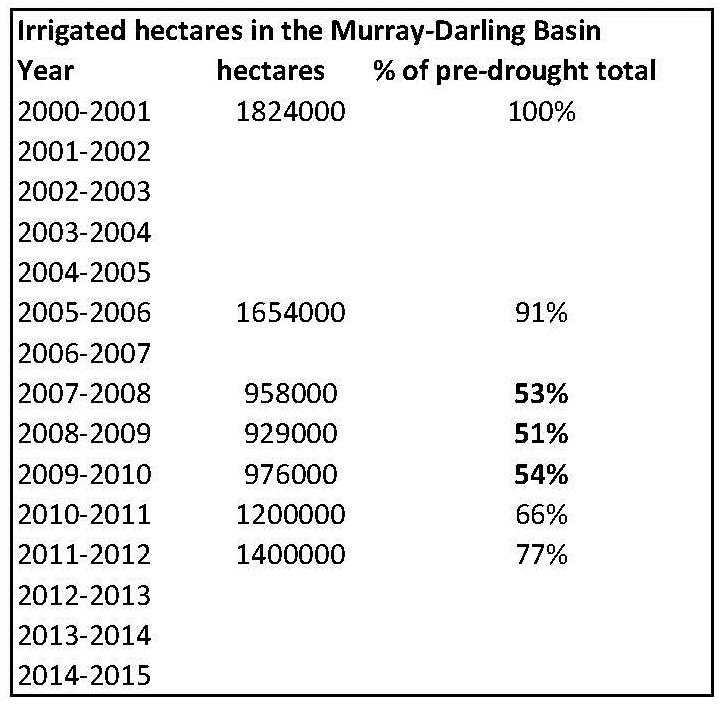
All of Australia’s urban water use efficiency is very nice and California should copy the good parts.  There isn’t a good role for household cisterns here because we don’t have a monsoon climate. But let’s point out what Australia really did.  They talk big talk about modernizing their district-level irrigation delivery systems (all those new gates for a billion dollars; I do wonder how all those moving parts are holding up) and their water markets.  But those are just mechanisms.  What they did was fallow half their irrigated ag during the drought.  A third of their irrigated ag is still retired.

It took me a lot of looking to find this, but here are the stats from the Australian Bureau of Statistics Series 4610 (and also 4618).

And 2012 was apparently an extremely wet year.

The Murray-Darling Basin has no groundwater. When surface water went away, they lost half their irrigated hectaresacreage. Farmers here claim that a 6-8% loss of irrigated lands is a big deal, but when California gets serious about living within our annual water supplies, I predict something similar. We could look at Australia’s example for ways to do that, although frankly, even their water market doesn’t seem to have been a subjectively pleasant experience for Australian growers. I would like for us to do better by our growers, but so far we don’t even admit what is happening.

5 Comments

Filed under Uncategorized

I have questions too!

A more painful question is one posed by USC’s Jeffe: “When do we purposely hurt our economy in order to save water, and how do you explain to people that’s what you have to do?”

So far, no one in California, least of all its political leaders, has come up with an answer.

Really?  That is a very easy question to answer.  Here is a highminded answer:

California is rich enough that we can afford to leave some of our natural resources as living rivers and intact groundwater aquifers rather than converting them into cash.  If we were poor, we might have to sell off every nice thing we have in order to have cash wealth to support our people.  But we aren’t that poor and if we chose, we could take care of our people and have nice things even with a smaller for-profit economy.  Californians have long decided that we don’t have to destroy beaches to get every drop of oil out of oceanic oil fields, or cut down every last redwood for timber to sell abroad.  We can just as readily decide that the last of the fish in our rivers, or the benefits of a healthy aquifer are more important to us than a little bit more cash.

Here is an answer based on shameful demagoguery:

Why should some already rich almond farmers get to take the last of the rivers that run through your state and turn them into more cash in their pockets?  Why should the rest of us have to face cracking roads and overpasses as they pump our groundwater aquifers dry, give up our lawns and pools, so they can send a luxury snack to China and India?

Neither of those were hard to come up with, so politicians should ask me for answers more often.  What I wonder is why so few people ask the reciprocal question:

What do we need more cash for so urgently that we should let rivers dry up before they reach the sea and let our fish drown in warm shallow water?  What part of almond profits are so deeply valuable to the public that we should tolerate 5 million acrefeet of overdraft every year of the drought?  What is so sacred about that bit of profit that we should give up so much for it?

9 Comments

Filed under Uncategorized

That’s old school.

I liked this article fine, because it points out that there are trade-offs for most agricultural crops and farmers plant them for reasons.  I have said before that I tend not to care whether crops are “thirstier” because the difference isn’t that big, and I personally respect any well-managed irrigation method.  If we ever decide to do so, I’d prefer to judge crops by explicit values, such as whether it is an important source of calories for humans or whether it is deeply culturally relevant.  In that piece, Mr. Michael made the observation that:

Still, the nut boom has mostly been a rational reaction to changing economic circumstances. For years San Joaquin Valley farmers “were criticized for growing low-value crops,” Bowles Farming’s Cannon Michael said. “They took a huge risk on almonds, and now that’s what’s wrong.”

He’s right.  When I started blogging, the enviro line was that farmers grew too much low-value agricultural products and they should switch to higher value crops.  I believe the subtext was “so that they could make the same amount of money using less water and that would keep them happy and no one gets mad”.  I personally think of that as old-guard water environmentalism (I don’t get out much and don’t know whether anyone else sees it similarly).  My thinking was that climate change means we’re going to get substantially less water and be able to do much less with it.  That we would have to make choices about what we want to do with the precip we do get (or can catch).    That’s why I was never on board with “switch to almonds or vines.”  If we can’t irrigate as many acres, I’d rather have abundant table fruits and vegetables than snacks (or wine, or cheap meat and dairy).  I would certainly rather have table fruits and vegetables than provide snacks to the world.  Since then, I have also come to object to tree nuts for Piketty/Occupy-kinds of reasons.  They make rich people (who can afford the high capital costs of installation) richer by cheaply extracting California’s unprotected natural resources and selling them abroad.

These types of arguments are new to water policy; I can see why farmers might perceive this as environmentalists moving the goal posts.  From what I’ve seen in the media, I don’t think the environmentalists supporting almonds (and conversion to high value agriculture in general) have themselves changed their mind (although maybe they didn’t foresee the extensive expansion and reckless overdraft).  I think a new strain of environmentalist thought (more motivated by climate change adaptation and less concerned with finding win-win solutions with a decreasingly powerful agricultural sector) has entered the policy discussions.

6 Comments

Filed under Uncategorized

Maybe she’s in Nevada.

As this photographer struggles to convey the sheer immensity of removing one thousand acres of almond trees, her commenters make some helpful points.

***
An article on local resistance to measuring individual wells. That resistance needs some counterweights. I can think of two. First, a per-acre assessment for the costs of subsidence due to overdraft. Any farmer who wants to demonstrate, based on pumping records, that his or her assessment should be lower is welcome to switch to an assessment based on metered pumping. Second, a moratorium on permanent crops in basins with declining groundwater levels. Putting either or both of those in place would change the incentives for growers considerably. Neither requires measuring pumping well-by-well, but you’d shortly have growers requesting well metering and groundwater monitoring.

2 Comments

Filed under Uncategorized